
Types of Rattan
Types of Rattan
Round Rattan
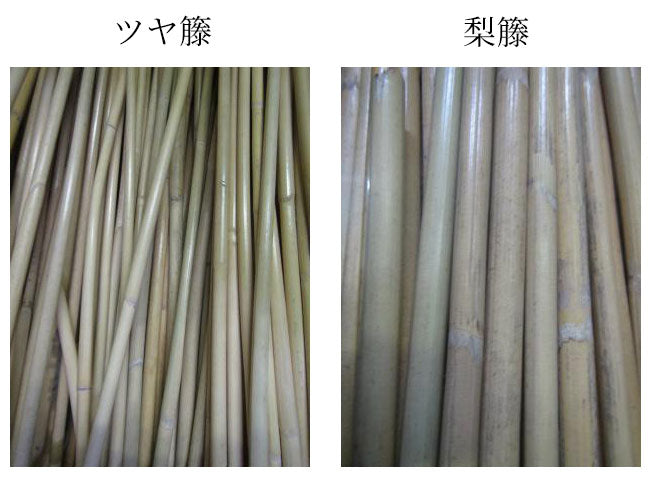
This is rattan material with the skin still attached. We handle glossy rattan and pear rattan.
- Glossy rattan
Glossy rattan is strong and hard, making it an ideal material for making large furniture and other pieces that will last a lifetime.
- Pear rattan
This is the base material for pear rattan round core, and it is soft and also suitable for making large furniture and other pieces.
Round rattan core
This is the inner part made by cutting the skin of Pear Rattan, a round rattan.
- Round rattan core, premium grade (AT/AR)
It is a high-quality material with a glossy finish, dense fibers, and durability. It is also soft and easy to weave. The surface of the rattan is carefully processed to minimize splinters. In addition, rattan has the characteristic of becoming softer the more it is bleached, and we have three types of materials available.
*AT is the highest quality, followed by AR.
- Unbleached
Because it is not bleached, you can enjoy the natural luster and off-white color that is unique to rattan as it ages. - Semi-bleached color (semi-bleached)
By semi-bleaching the material, it can be handled flexibly as a material that is softer than regular special grade and harder than genuine bleached material. - Bleached wood
Since it is a bleached product with a white skin, it is a material suitable for creating works that involve dyeing. It is also soft, making it suitable for detailed work.

- Round rattan core/thick
Round core The material is quite thick, making it ideal for areas that require thickness and strength, such as bag handles.

Material cut from a round rattan core
- Half cut round rattan core: A material made by cutting a round rattan core in half, with a semicircular cross section.
- Flat oval rattan core: A cut round rattan core with a kamapoko-shaped cross section.
- Flat/flat rattan core: A material made by cutting out only the center part of a round rattan core, with a rectangular cross section.

Rattan skin peel
This is the inner part made by sawing the bark of a round rattan tree.
- Rattan skin peel/tuya rattan skin peel natural color (not bleached or dyed)
This material is made by splitting and sawing glossy rattan and adjusting only the bark to a uniform width and thickness.
- Rattan skin peel, chamfered edges, made from high-quality material, cut one by one by craftsmen in Japan.
- Back-removing rattan skin peel, Rattan skin peel has been processed by removing the back, making it a softer and more flexible material.
- H Backrest Thin Rattan skin peel The thin rattan skin peel backrest is processed to be thinner than regular backrest, and is a thinner and softer material.

- Kyakutan,/Kyakutan rattan skin peel natural color (not bleached or dyed)
Only the skin of the pear rattan is adjusted to a certain width and thickness.

Dyeing and processing products
Some rattan skin peel products are dyed. The difference between the regular and H versions is the order of the dyeing.
*Dyed products will be discontinued in the future due to environmental concerns, so please purchase them as soon as possible.
- Dyed round rattan core Dyed round rattan core
- Dyed Rattan skin peel: Glossy rattan (round rattan) dyed domestically
- Dyeing: Glossy rattan (round rattan) dyed after being dyed domestically
- H-dyed Rattan skin peel Glossy Rattan (Round Rattan)
- H-dyed backing, thinly dyed Rattan skin peel, with the back removed. Glossy rattan (round rattan)
- Dyed rattan (round rattan) dyed domestically

Materials other than rattan
- Akebi vines
Akebi vines are very expensive vines in Japan and are used as materials for traditional crafts such as baskets.
